
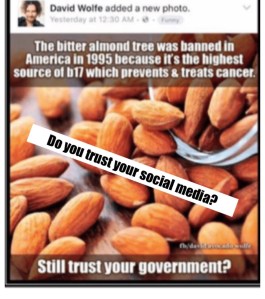
Access to the internet has grown exponentially over the years and studies show the third most popular use of the internet is to search for health information (Pollard, et al. 2015). Memes are a popular sensation that have the capacity to reach millions of people and can strongly influence beliefs. The meme, pictured above, highlights the potential devastation of this if our children lack health literacy skills. This meme questions the validity of information seen on social media as the original picture shows false claims on the health benefits of bitter almond trees. To combat this, health literacy and critical inquiry skills are a focal area in VCE HHD.
 The key knowledge and skills highlighted in the Food and Nutrition topic, involves students developing knowledge to source nutrition information and the ability to evaluate validity of information (VCAA, 2017). Participatory approaches should be included to ensure lessons are effective and students are engaged (Cahill, et al. 2014). Participatory approaches can be included in every lesson plan by simply including student led discussions, role-play, small group problem solving and critical thinking tasks (Cahill, et al. 2014).
The IVAC model is a tool used to build student’s action competence and can be used to plan lessons that incorporate participatory approaches (Carlsson & Simovska, 2012). In addition to this, the key propositions need to be included in order to provide contemporary lesson plans (Welch & Leahy, 2012). An activity involving the school canteen can be introduced using the IVAC model.
Phase 1, Investigation,would involve educative focus and health literacy skills as student’s source and evaluate credible resources for food infor
mation as they compare their school canteen menu. The second and third phase, Vision andAction, both take a strengths-based approach as students use their own resources and knowledge to develop plans and then carry out their idea (ACARA, 2018). The forth phase Change, involves critical inquiry where students put the new menu in place and analyse and evaluate ways in which they can get other students on board to make a long-term change (ACARA, 2018).
While the IVAC model and participatory approaches are effective for student’s learning, there are implications for the teachers. Implications of these two ideas as studies show, include lack of training and resources, time constraints and classroom management (Cahill, et al. 2014). These barriers should be considered and planned for in order for effective pedagogy to be feasible.
References
Australia Curriculum Assessment and Reporting Authority (2018). Health and Physical Education Propositions. Retrieved from https://www.australiancurriculum.edu.au/f-10-curriculum/health-and-physical-education/key-ideas/
Cahill, H., Coffey, J., Lester, L., Midford, R., Ramsden, R., & Venning, L. (2014). Influences on teachers’ use of participatory learning strategies in health education classes. Health Education Journal, 73(6), 702–713. https://doi.org/10.1177/0017896913513892
Carlsson, M., & Simovska, V. (2012). Exploring learning outcomes of school-based health promotion – a multiple case study. Health Education Research, 27, 3, 437-447.doi:10.1093/her/cys011
Pollard, C. M., Pulker, C. E., Meng, x., Kerr, D. A. & Scott, J. A. (2015). Who Uses the Internet as a Source of Nutrition and Dietary Information? An Australian Population Perspective. J Med Internet Res., 17(8). doi: 10.2196/jmir.4548
Victorian Curriculum and Assessment Authority (2017).Health and Human Development Study Design 2018-2022. Retrieved from: https://www.vcaa.vic.edu.au/Documents/vce/hhd/HealthHumDevSD-2018.pdf
Welch, R., and Leahy, D. (forthcoming, 2018). Beyond the pyramid or plate: Contemporary approaches to Food and Nutrition education. Active and Healthy Journal
 Health Education in the Secondary Years